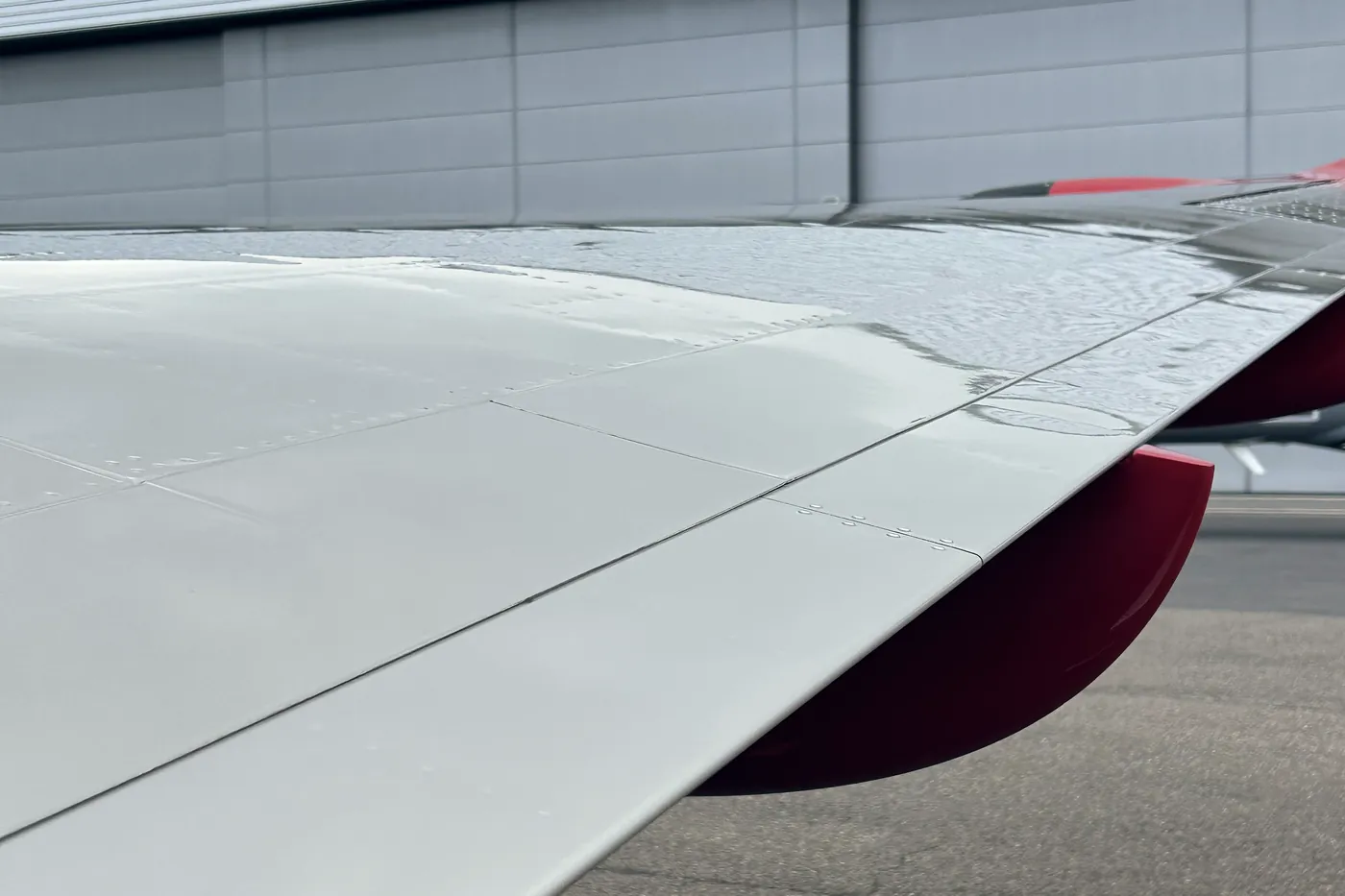
You Do Not Need to Wash It After Every De-Icing
No regulator, airframer or fluid manufacturer says you must wash an aircraft after each de-icing treatment.
The problem is cumulative. Residue collects where repeated applications of thickened fluid have been left to dry, over weeks and months of winter flying.
The more often your aircraft is de-iced, the more of it there is to deal with.
Why De-Icing Fluid Does Not Just Rinse Off
There are four types of fluid, and only some of them cause this.
Type I is thin. It runs off quickly, which is why it only protects you for a short time. It is sprayed hot to melt what is already on the aircraft.
Types II, III and IV are thickened. A thickening agent keeps the fluid on the wing through taxi, holding off frost until it blows clear at rotation. Type IV lasts longest.
That is the whole point of the product. It is also the problem. A fluid built to stay on a wing at taxi speed is not going to be rinsed off by rain.
Where the airflow catches it, it goes. Where it does not, it dries.
Where It Ends Up, and What It Does to the Paint
Mostly, onto the paint. The fluid is sprayed over the top of the aircraft and runs down everything below it, so the finish takes the bulk of it.
Fresh fluid is not the problem. Approved de-icing fluids are tested against aircraft coatings – they have to not streak, discolour or blister paint – and they carry a corrosion inhibitor package. Sprayed on and shed at rotation, they do what they are supposed to.
This is not a fringe view. Maintenance guidance from the business aviation world is to wash the aircraft after de-icing fluid has been applied. It puts de-icing fluid in the same bracket as salt.
The problem is the film it leaves. Dried glycol goes sticky rather than hard, so it holds dust, grit and insect debris against the finish. Grit sitting on paint is abrasive, and every month it stays there it cures harder and gets more difficult to lift.
Whatever ran off the top ends up on the belly, mixed with brake dust. That is the part nobody looks at, and the part that stains worst.
Some of it also dries in the gaps and cavities the airflow never reaches, including around the flying controls. A wing can look spotless and still have dried fluid in the gaps. That matters more on some aircraft than others, which is the next section.
One thing worth knowing either way: diluted Type II and IV leave more residue than neat fluid. The mix ratio matters, and you are not the one choosing it.
Which Aircraft It Matters Most For
There is a safety argument about this residue, and it is worth knowing whether it applies to you.
Dried thickener absorbs water. In humidity or rain it swells back into a gel, and if the aircraft then climbs into the cold, that gel can freeze. Frozen residue in the wrong gap has been linked to restricted flight controls.
That risk sits almost entirely on aircraft where the pilot moves the control surface directly, through cables and rods, with nothing but muscle in between. If something is jamming the surface there is no extra force to push through it. Mostly older airliners and turboprops, and that is where the documented incidents are.
On most modern jets a hydraulic system does the moving. The pilot commands it and the force comes from the aircraft, far more than frozen residue is going to resist. Manufacturers of those types have said they see no evidence of a problem.
So for most operators reading this, the flight control argument is not the one that matters. It is also not something a cleaning company can solve. That belongs with your maintenance organisation.
What is left is the paintwork, which is a slower problem than a jammed control and the one that actually costs you money.
When To Actually Clean It Off
Temperature decides this, not the calendar – and it decides how, more than whether. Warm is better, and warm can happen mid-winter.
A heated hangar. It does not matter that it is January outside. Inside, the fluid softens and it can be cleared properly. If it is going in for downtime or maintenance anyway, that is an opportunity to get your aircraft cleaned.
Flying somewhere milder. Say the aircraft spends a week doing sub-zero mornings in Aspen, then flies back to New York where it is six degrees. Six degrees is above freezing, so clean it in New York. There is no reason to wait for spring.
The cold weather ending at base. The usual one, and worth doing properly rather than letting a winter of film sit through to summer.
If none of those are coming, the cold is still not a hard stop. A wet wash is – several hundred litres onto a freezing airframe makes a problem rather than removing one. A rinseless wash uses around twenty litres applied by cloth, so there is no standing water to freeze. It can be done cold. It is just better warm, and the clock is running either way.
What a Clean Covers, and What It Does Not
The paintwork is the part that can be dealt with, and doing it properly is the whole job.
A thorough exterior clean takes the glycol film off before it has a season to cure on. The top surfaces, the panel gaps, and the belly, where everything that ran down the aircraft has collected.
How it comes off matters, because that is where paint gets damaged. Dried glycol has to be softened and lifted. Drag a grit-loaded film across a finish and you will mark it; reach for a solvent strong enough to shift it in one pass and you will do worse.
The Short Version
Most of the fluid lands on your paint, and the film it leaves holds grit against the finish until something takes it off. Older aircraft with manual controls have a second problem. Modern jets mostly do not.
It does not need doing the day after a de-icing. It does need doing at the first opportunity the weather gives you, not the last: a heated hangar, a trip somewhere milder, or the end of the cold.
Related reading
Had a heavy winter? Tell us the type, the base and roughly how often it has been de-iced.
Get a Quote